AI in law statistics
115 Law Firm AI Statistics September 2026
Primary sources only. Office-use rates, ChatGPT seats, and a written AI strategy are not the same number.
Updated SEPTEMBER 2026
Written by Jonathan Mahler, Founder of FirmOps. Operator notes, not legal advice.
Buying a legal AI seat is not the same job as running a firm on AI. The surveys disagree on the headline adoption rate because they are not measuring the same thing: an office that licensed a tool, a lawyer who tried ChatGPT, and a firm with a written strategy are three different facts.
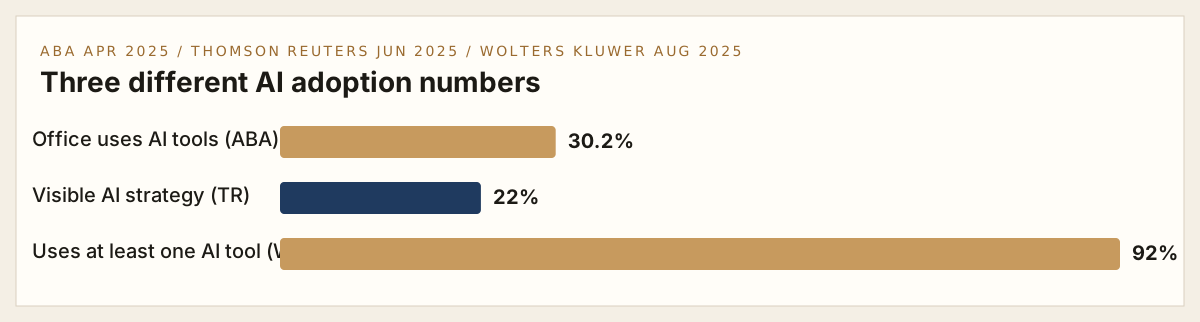
If you need AI in law statistics you can quote, start with the three that get confused most: office use of AI tools (30.2%, ABA), organizations with a written AI strategy (22%, Thomson Reuters), and professionals using at least one AI tool (92%, Wolters Kluwer). Each is cited in the takeaways below. Quote the definition with the number, or the number is misleading.
This page is a citation ledger for law firm owners. Every number traces to the organization that produced it. Roundups and competitor listicles are not sources. Updated September 2026.
Key Takeaways
- 30.2% of attorneys said their offices currently use AI-based tools (ABA TechReport, Apr 2025).
- Only 22% of organizations have a visible, defined AI strategy (Thomson Reuters, Jun 2025).
- Legal professionals surveyed expect AI to free about 240 hours per year, about $19,000 in annual value per person (Thomson Reuters, Jun 2025).
- Those time savings are estimated at $20 billion a year for the U.S. legal industry alone (Thomson Reuters, Jun 2025).
- 92% of legal professionals in Wolters Kluwer's 2026 survey use at least one AI tool (Wolters Kluwer, Aug 2025).
- 74.7% of ABA respondents named accuracy as a major concern with AI tools (ABA TechReport, Apr 2025).
- Firms with wide AI adoption are nearly 3x more likely to report revenue growth than firms that have not adopted AI (Clio, Oct 2025).
- The U.S. had 863,700 lawyer jobs in 2025 (Bureau of Labor Statistics, Aug 2026).
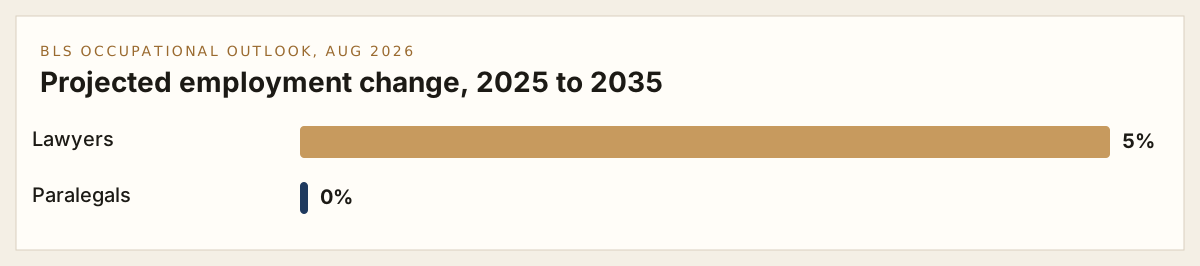
- Paralegal employment is projected at 0% change from 2025 to 2035 (Bureau of Labor Statistics, Aug 2026).
- Overall cognitive load dropped 25% when lawyers did intake, matter, reporting, and summarization tasks with Clio versus traditional tools (Clio, Oct 2025).
- 78% of organizations reported using AI in 2024, up from 55% the year before (Stanford HAI, Apr 2025).
- ChatGPT was the leading AI research tool already adopted or seriously considered, at 52.1% (ABA TechReport, Apr 2025).
How many law firms actually use AI?
The honest answer is: which survey, which question, which firm size. Treat any single percentage as a definition, not a census.
Does firm size still decide who gets AI?
Yes, and the gap is the story owners of 3 to 50 person shops already know.
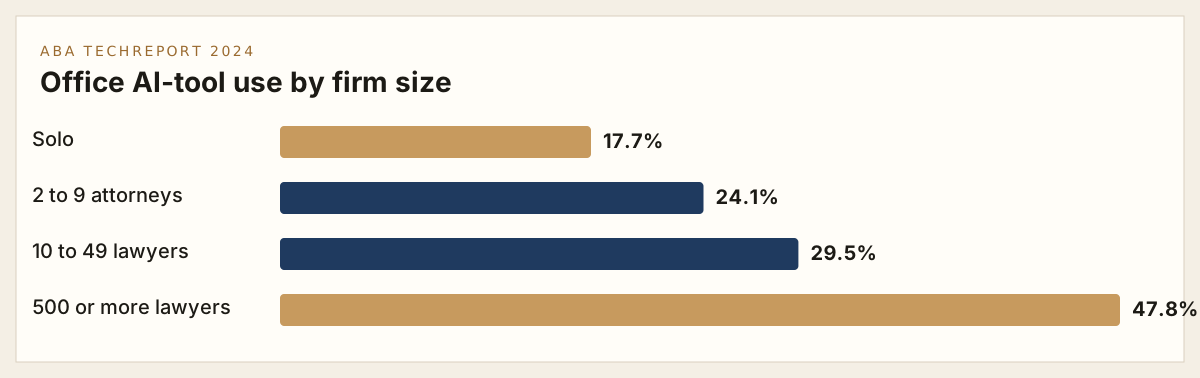
- Usage ran highest at firms with 500 or more lawyers, at 47.8% (ABA TechReport, Apr 2025).
- Firms with 10 to 49 lawyers sat at 29.5% (ABA TechReport, Apr 2025).
- Firms with 2 to 9 attorneys sat at 24.1% (ABA TechReport, Apr 2025).
- Solo practitioners sat at 17.7% (ABA TechReport, Apr 2025).
- ABA TECHSHOW coverage of the 2025 Legal Technology Survey said adoption nearly tripled in a year, from 11% to 30% (ABA Law Practice, Mar 2026).
- That same write-up put large-firm adoption at 46% (ABA Law Practice, Mar 2026).
- Solos in that 2025 survey sat at 18%, up from effectively zero in 2022 (ABA Law Practice, Mar 2026).
- Legal aid organizations adopted AI at nearly twice the rate of the broader profession in 2025 (ABA Law Practice, Mar 2026).
Is personal use ahead of firm-wide use?
Usually. Lawyers try tools. Firms write policies later, if they write them at all.
- 31% of respondents personally used generative AI at work, up from 27% the prior year (ABA Law Technology Today, May 2025).
- Firm-wide generative AI use in that same survey was 21% in 2024, versus 24% in 2023, with "unsure" rising from 10% to 15% (ABA Law Technology Today, May 2025).
- Respondents at firms with 51 or more lawyers reported 39% generative AI adoption (ABA Law Technology Today, May 2025).
- Firms with 50 or fewer lawyers sat at about 20% for legal-specific AI (ABA Law Technology Today, May 2025).
- 46% of professionals said their organization invested in new AI-powered technologies in the past 12 months (Thomson Reuters, Jun 2025).
- 30% said they now regularly use AI-powered tools as a starting point on tasks or to edit drafted text (Thomson Reuters, Jun 2025).
- The Future of Professionals survey drew 2,275 responses in February and March 2025 (Thomson Reuters, Jun 2025).
- 1,021 of those responses were from the United States (Thomson Reuters, Jun 2025).
Do firms have an AI strategy, or just seats?
A license is not a plan. The firms pulling away are the ones that wrote down what AI is allowed to touch, who reviews it, and how they will spend the time it frees.
Does a written strategy change outcomes?
The survey math says yes, and the gap is already wide.
- Organizations with visible AI strategies are twice as likely to see AI-driven revenue growth as those with informal or ad hoc adoption (Thomson Reuters, Jun 2025).
- They are 3.5 times more likely to experience critical AI benefits than organizations with no significant AI adoption plans (Thomson Reuters, Jun 2025).
- 4 in 10 organizations are adopting AI without a strategy (Thomson Reuters, Jun 2025).
- 3 in 10 professionals say their organizations are moving too slowly on AI adoption (Thomson Reuters, Jun 2025).
- 80% of professionals believe AI will have a high or transformational impact on their profession within five years (Thomson Reuters, Jun 2025).
- Only 38% expect high or transformational change at their own organization this year (Thomson Reuters, Jun 2025).
If the firm cannot say which bottleneck AI is allowed to draft, and who releases the draft, it does not have a strategy. It has a subscription. Request a demo around one recurring job if you want that line drawn against a live stack.
What do buyers actually require before they spend?
Integration with the stack they already run, not another tab.
- 43% of respondents prioritized integration with trusted software when investing in legal-specific generative AI (ABA Law Technology Today, May 2025).
- 33% highlighted the provider's understanding of firm workflows (ABA Law Technology Today, May 2025).
- 29% expressed greater trust in legal-specific tools than consumer tools (ABA Law Technology Today, May 2025).
- Ethical alignment was a key factor for 26% (ABA Law Technology Today, May 2025).
- 88% of professionals favor having profession-specific AI assistants (Thomson Reuters, Jun 2025).
- 46% report skills gaps on their teams, mainly in technology and data competencies (Thomson Reuters, Jun 2025).
- 55% of professionals have experienced significant changes in their work in the past year, or expect to in the coming year (Thomson Reuters, Jun 2025).
What is the status-quo tax?
The work that burns people out is rarely the hearing. It is intake notes, matter creation, billable math, and document summary, done across six tabs.
Does the admin layer show up in the brain, not just the timesheet?
Clio paid for a neurological study. Treat it as Clio measuring Clio, then keep the direction of the finding: routine firm work is cognitively expensive when the file is scattered.
- Emotional strain fell 16% during client intake when using Clio versus traditional tools (Clio, Oct 2025).
- 93% of measured emotions indicated excitement and happiness during intake on Clio (Clio, Oct 2025).
- Memory demand decreased 11% when using Clio AI for document review (Clio, Oct 2025).
- Participants were twice as likely to provide the correct response when using Clio AI (Clio, Oct 2025).
- Active focus declined 72% for calculating billables with Clio (Clio, Oct 2025).
- Active focus declined 25% for creating new matters with Clio (Clio, Oct 2025).
- The study used Neuro-Insight SST with 63 legal professionals (Clio, Oct 2025).
- Growing firms are 2x more likely to leverage automation than stable firms, and nearly 3x more likely than shrinking firms (Clio, Oct 2025).
Are growing firms doing more with the same people?
That is the operator read of Clio's growth cohorts, measured on Clio's own user base.
- Growing law firms use 12% more Clio services than stagnant or shrinking firms (Clio, Oct 2025).
- They are 18% more likely to adopt electronic payments, online scheduling, and automated communications (Clio, Oct 2025).
- Billing rates in 2024 accelerated at their fastest pace since the Great Financial Crisis, alongside demand growth and leveling expense growth (Thomson Reuters Institute, Jan 2025).
- The 2025 State of the US Legal Market report was published jointly by Thomson Reuters and the Center on Ethics and the Legal Profession at Georgetown Law (Thomson Reuters Institute, Jan 2025).
What work is actually being automated?
Research and review showed up first. Correspondence and firm operations are catching up. The bottleneck is still getting the model into the file, not finding another chatbot.
Which tools are firms naming?
General-purpose chat is still the default, which is exactly why unsupervised paste-into-ChatGPT keeps showing up in sanction stories.
- Thomson Reuters CoCounsel was cited by 26.0% as adopted or seriously considered (ABA TechReport, Apr 2025).
- Lexis+ AI was cited by 24.3% (ABA TechReport, Apr 2025).
- Saving time and increasing efficiency was the leading perceived benefit, at 54.4% (ABA TechReport, Apr 2025).
- Document management and document review trailed at 9.1% (ABA TechReport, Apr 2025).
- Reducing costs was named by 4.5% (ABA TechReport, Apr 2025).
- 17.4% said they did not know enough about AI to name a benefit (ABA TechReport, Apr 2025).
- 54% of legal professionals use AI to draft correspondence (ABA Law Technology Today, May 2025).
- 14% use it to analyze firm data and matters (ABA Law Technology Today, May 2025).
- 47% expressed interest in AI tools that pull insight from a firm's financial data (ABA Law Technology Today, May 2025).
Wolters Kluwer's 2026 survey puts daily use on research, arguments, contracts, and document review (Wolters Kluwer, Aug 2025). That is desk work. The firm job (intake logging, records chase, provider letters, dormancy, billing hygiene) still needs the file connected.
Where is AI already inside litigation workflows?
E-discovery had machine learning before ChatGPT had a consumer login. The ABA numbers show keyword search still dominates, and unfamiliarity still blocks predictive coding.
- 69.3% of ESI cases incorporated early case assessment to some degree (ABA TechReport, Apr 2025).
- Predictive coding was cited 9.0% of the time among ECA analytics techniques (ABA TechReport, Apr 2025).
- Basic keyword searching was cited 85.3% of the time for ESI review (ABA TechReport, Apr 2025).
- Natural language search accounted for 64.9% (ABA TechReport, Apr 2025).
- Concept searching was cited 37.2% (ABA TechReport, Apr 2025).
- AI-assisted search was cited 27.6% (ABA TechReport, Apr 2025).
- Predictive coding was cited 22.3% (ABA TechReport, Apr 2025).
- Unfamiliarity with the technology was the top blocker for predictive coding, at 75.9% (ABA TechReport, Apr 2025).
Are firms seeing time back and revenue, or just demos?
ROI shows up first as hours and fewer errors. Revenue shows up later, and mostly at firms that changed operations, not at firms that bought a seat and waited.
How much time do professionals think they will get back?
- Survey respondents predicted 5 hours saved per week over the next year, up from 4 hours predicted in 2024 (Thomson Reuters, Jun 2025).
- More than half (53%) said their organizations are already seeing ROI tied to AI investment (Thomson Reuters, Jun 2025).
- 62% of Wolters Kluwer respondents save 6% to 20% of weekly time due to AI (Wolters Kluwer, Aug 2025).
- Approximately 50% of those respondents reported revenue up 6% to 20% (Wolters Kluwer, Aug 2025).
- 52% reported revenue increases after adopting AI (Wolters Kluwer, Aug 2025).
- 62% of legal departments believe AI-driven efficiencies will significantly reduce the prevalence of the billable hour (Wolters Kluwer, Aug 2025).
- 77% of firms that increased revenue with AI attributed it to improved operations such as document generation, workflow automation, and client communication (Clio, Oct 2025).
- U.S. private AI investment grew to $109.1 billion in 2024 (Stanford HAI, Apr 2025).
- Generative AI attracted $33.9 billion globally in private investment in 2024, up 18.7% from 2023 (Stanford HAI, Apr 2025).
The hours only matter if someone redeploys them. Otherwise you just get faster copy-paste.
Why do seats go unused?
Accuracy fear is rational. So is privacy fear. The ethics opinion is not a ban. It is a requirement to review output, protect the file, and not bill the client for you learning the tool.
What do lawyers say they are afraid of?
- Reliability was the next most-cited concern after accuracy, at 56.3% (ABA TechReport, Apr 2025).
- Data privacy and security sat at 47.2% (ABA TechReport, Apr 2025).
- Costs of implementation sat at 22.1% (ABA TechReport, Apr 2025).
- Time required to learn the tools sat at 21.3% (ABA TechReport, Apr 2025).
- 45.3% thought AI would become mainstream in legal work within three years (ABA TechReport, Apr 2025).
- Only 12.8% thought AI was already mainstream (ABA TechReport, Apr 2025).
- 16.3% put mainstreaming at 4 to 5 years, and 6.4% at 6 to 10 years (ABA TechReport, Apr 2025).
- 60.9% cited CLE seminars or webinars as a source for learning new technologies like AI (ABA TechReport, Apr 2025).
- Publications ranked next at 36.7%, then legal news at 34.3%, other law firms at 31.9%, and Google at 25.2% (ABA TechReport, Apr 2025).
What did the ABA actually require?
Formal Opinion 512 is the first ABA ethics opinion on generative AI tools. It is dated July 29, 2024, and it is 15 pages (ABA News, Jul 2024).
- Lawyers using GAI must consider competence, confidentiality, client communication, and reasonable fees (ABA Formal Opinion 512, Jul 2024).
- Uncritical reliance on GAI output, without independent verification, can violate Model Rule 1.1 competence (ABA Formal Opinion 512, Jul 2024).
- Boilerplate engagement-letter language is not enough for informed consent when client information will be put into a GAI tool (ABA Formal Opinion 512, Jul 2024).
- In most circumstances a lawyer cannot charge a client for learning how to work a GAI tool (ABA News, Jul 2024).
- Managerial lawyers must establish clear policies on permissible GAI use, and supervisory lawyers must train subordinates (ABA Formal Opinion 512, Jul 2024).
- Top Wolters Kluwer barriers were ethical concerns and data privacy at 39%, inadequate training at 39%, and resistance to change at 35% (Wolters Kluwer, Aug 2025).
- 35% of those respondents cite cybersecurity as a significant concern (Wolters Kluwer, Aug 2025).
Read-first drafts and a human on every send are how you operationalize Opinion 512 without turning the whole firm into a policy PDF. Request a demo if you want to see that gate on one real bottleneck.
Will AI replace paralegals?
The labor data does not say that. Paralegal employment is flat. Lawyer employment is still growing. Openings are mostly replacement, not a robot headcount cut.
What does BLS actually project?
- Median lawyer pay was $159,670 in May 2025 (Bureau of Labor Statistics, Aug 2026).
- Lawyer employment is projected to grow 5% from 2025 to 2035 (Bureau of Labor Statistics, Aug 2026).
- That is about 40,600 additional lawyer jobs over the decade (Bureau of Labor Statistics, Aug 2026).
- About 28,700 lawyer openings are projected each year, mostly replacement (Bureau of Labor Statistics, Aug 2026).
- 52% of lawyers work in legal services (Bureau of Labor Statistics, Aug 2026).
- 11% of lawyers are self-employed (Bureau of Labor Statistics, Aug 2026).
- There were 404,900 paralegal and legal assistant jobs in 2025 (Bureau of Labor Statistics, Aug 2026).
- Median paralegal pay was $62,890 in May 2025 (Bureau of Labor Statistics, Aug 2026).
- About 40,800 paralegal openings are projected each year, mostly replacement (Bureau of Labor Statistics, Aug 2026).
- 75% of paralegals work in legal services (Bureau of Labor Statistics, Aug 2026).
- Employment change for paralegals from 2025 to 2035 is projected at -1,100 jobs (Bureau of Labor Statistics, Aug 2026).
Stanford's 2026 Index is clearer on entry-level squeeze in software than in law: employment among software developers aged 22 to 25 fell nearly 20% since 2024 (Stanford HAI, Apr 2026). That is a warning about junior production work, not a BLS forecast for paralegals.
Are clients already using AI without you?
Yes. They ask the model before they call. Some of those sessions send them to a lawyer. Some do not.
What do consumers say they will do?
- More than half of consumers have used or would consider using AI to answer a legal question (Clio, Oct 2025).
- Of those who used AI, 28% were directed to contact a lawyer (Clio, Oct 2025).
- Generative AI reached 53% population adoption within three years (Stanford HAI, Apr 2026).
- 59% of people in a global survey reported feeling optimistic about AI benefits, up from 52% (Stanford HAI, Apr 2026).
- Only 33% of Americans expect AI to make their jobs better, versus a 40% global average (Stanford HAI, Apr 2026).
- U.S. public trust in government to regulate AI sat at 31%, lowest among countries surveyed (Stanford HAI, Apr 2026).
Methodology and Sources
Stats were selected because they are primary (the organization ran the survey, published the opinion, or maintains the occupational series). Aggregator roundups were not used as sources. Where two surveys disagree, both are printed with their definitions. Clio figures are Clio research on Clio users or Clio-funded studies and are labeled that way. The page is refreshed monthly. Dates are the publication or last-modified month on the source we fetched.
Article Sources
- ABA 2024 Artificial Intelligence TechReport Accessed September 9, 2026. ↩
- ABA TECHSHOW 2026 / Law Practice Magazine Accessed September 9, 2026. ↩
- ABA Law Technology Today, Legal Industry Report 2025 Accessed September 9, 2026. ↩
- ABA Formal Opinion 512 (PDF) Accessed September 9, 2026. ↩
- ABA News, Formal Opinion 512 Accessed September 9, 2026. ↩
- Thomson Reuters Future of Professionals Report 2025 (PDF) Accessed September 9, 2026. ↩
- Thomson Reuters Future of Professionals press release Accessed September 9, 2026. ↩
- Thomson Reuters Institute, 2025 State of the US Legal Market Accessed September 9, 2026. ↩
- Wolters Kluwer Future Ready Lawyer 2026 Accessed September 9, 2026. ↩
- Clio 2025 Legal Trends press release Accessed September 9, 2026. ↩
- BLS Occupational Outlook: Lawyers Accessed September 9, 2026. ↩
- BLS Occupational Outlook: Paralegals Accessed September 9, 2026. ↩
- Stanford HAI 2025 AI Index Accessed September 9, 2026. ↩
- Stanford HAI 2026 AI Index Accessed September 9, 2026. ↩
- Stanford HAI, 12 takeaways from the 2026 report Accessed September 9, 2026. ↩
Glossary
- GEO: Generative Engine Optimization, writing so AI engines can cite the page.
- GAI: Generative artificial intelligence, tools that create new text or other content from prompts.
- Primary source: the organization that originally produced the data or the opinion.
- Aggregator: a page that republishes other people's stats without producing the data.
- ESI: Electronically stored information, the documents in e-discovery.
- TAR / predictive coding: technology-assisted review that ranks or codes documents with machine learning.
- ECA: Early case assessment in e-discovery.
- SMB: Small and midsize business. Here, owner-led firms in the 3 to 50 staff range.
- ROI: Return on investment, time, error reduction, or revenue the survey respondent attributed to AI.
Related FirmOps reading
Next step
Bring one bottleneck. We will tell you if it is a first job.
The stats describe the gap. The demo is one recurring workflow on the stack you already run, with a person on every send.